


Sacramento, CA…Since 2024, California has seen double-digit declines in every major crime category tracked, including: homicide 18.6%, robbery 19.9%, property crime 14.3%, motor vehicle theft 25.8%, and violent crime 10.2%. In 2025, every major statewide crime rate fell — and California recorded its lowest homicide rate since statewide reporting began in 1966.
Here’s a California public safety story you probably won’t see on Fox News – crime is way down. In fact, California just recorded its lowest homicide rate in state history, while every major statewide crime category declined in 2025.
That did not happen by accident. Every major statewide crime rate declined in 2025 and California’s homicide rate is now 3.5 per 100,000 — the lowest recorded since statewide reporting began nearly six decades ago.
That progress reflects a sustained, whole-of-government approach to public safety: putting more law enforcement officers on the ground, giving state and local agencies better tools, disrupting organized criminal networks, keeping guns out of dangerous hands, taking deadly drugs out of circulation and investing in prevention and intervention.
Some people have built a business out of telling Californians that their state is falling apart. The facts tell a different story. Crime is down across the board. Homicides are at a historic low. We’re doing the work, measuring the results and making California safer.
Governor Gavin Newsom
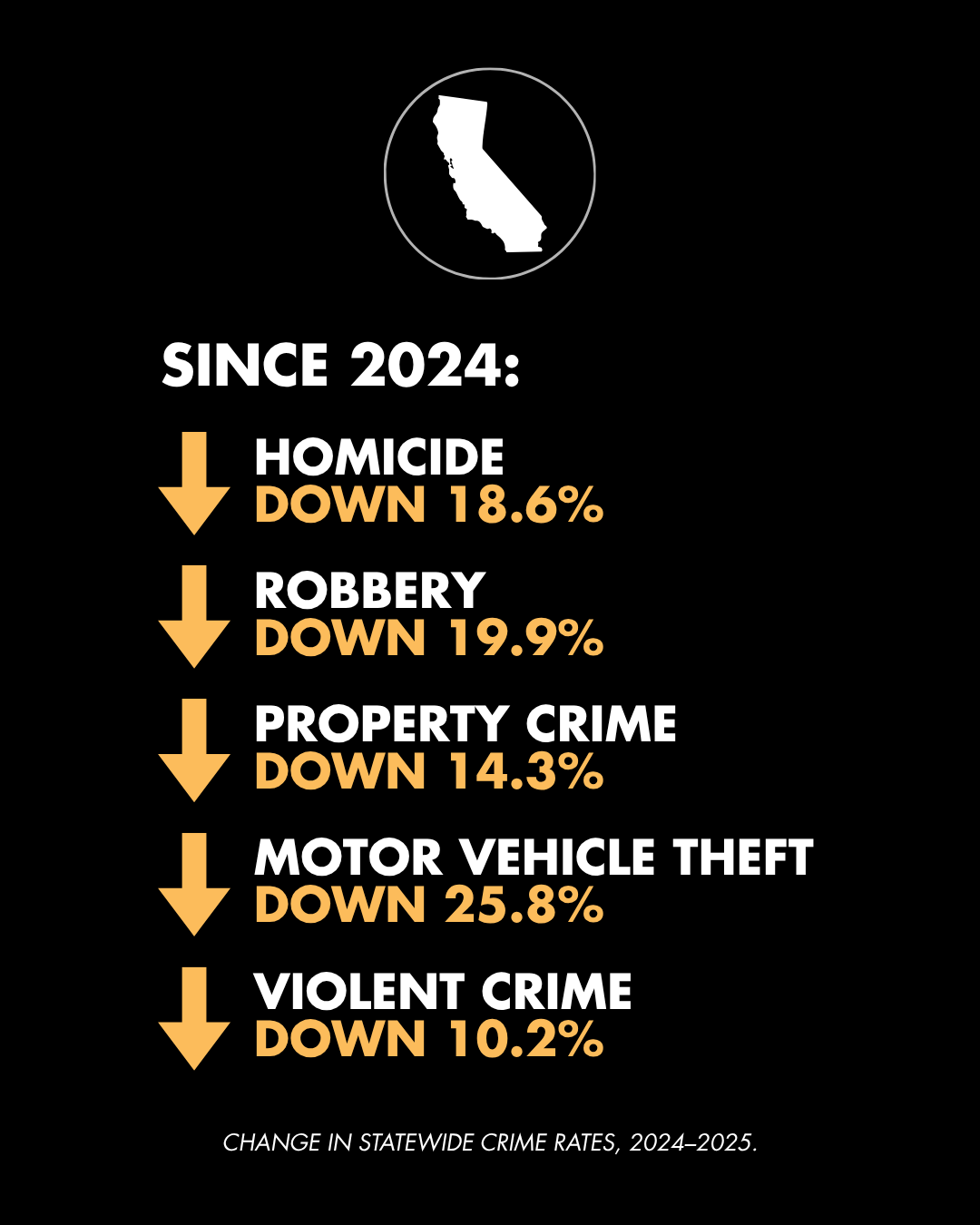
Since 2024, California saw double-digit declines in every major crime category tracked, including:
- Homicide: ↓ 18.6%
- Robbery: ↓ 19.9%
- Property crime: ↓ 14.3%
- Motor vehicle theft: ↓ 25.8%
- Violent crime: ↓ 10.2%
California’s homicide rate is now 3.5 per 100,000 — the lowest rate since statewide reporting began in 1966.
Since Governor Newsom took office, the homicide rate is down 20%, robbery 31%, property crime 24%, motor vehicle theft 19% and violent crime 3%.
Comparing California to other states
California’s homicide rate remains substantially lower than rates in many other states. According to CDC data from 2024, the latest year available for all states, California’s homicide rate fell from 5.1 to 4.5 per 100,000. Mississippi’s rate (19.7) was more than four times California’s; Louisiana’s rate (15.2) was more than three times California’s; Alabama’s rate (13.3) was nearly three times California’s; and Tennessee (10.0), South Carolina (9.9), Missouri (9.4), and Georgia (9.2) all had rates more than double California’s.
State and local law enforcement working together
Public safety works best when state and local law enforcement have the resources and capacity to work together.
That is why California has invested in deeper regional partnerships through the California Highway Patrol, allowing state officers to work side-by-side with local police departments and sheriffs to target crime where it is most concentrated. In 2024, California also reached its goal of adding 1,000 new CHP officers, strengthening the state’s ability to support local law enforcement and respond to crime statewide.
In 2025, CHP crime suppression teams expanded to San Diego, the Inland Empire, Los Angeles, the Central Valley, the Sacramento Valley and the San Francisco Bay Area, bringing sustained enforcement and greater visibility to communities that need it most.
Going after organized crime — not just individual crimes
Organized retail theft does not stop at a city or county line. Criminal networks operate across jurisdictions, which is why California built a statewide response.
Established in 2019, the Organized Retail Crime Task Force has brought law enforcement, prosecutors and retailers together to identify and dismantle organized theft networks. California has backed that strategy with major investments in local enforcement, investigative technology, regional operations and vertical prosecution.
In 2023, Governor Newsom launched the largest-ever state investment in organized retail theft, awarding more than $242 million to 38 local law enforcement agencies.
California leads the nation on gun safety
California believes gun violence is preventable — and has built a national model for doing something about it.
The state is ranked #1 in the nation for gun law strength by both the Giffords Law Center and Everytown for Gun Safety and consistently maintains one of the nation’s lowest firearm death rates.
California put robust state investment in community violence intervention on the map. What began as a $9 million-a-year program grew roughly eightfold—more than the state had invested in all prior years combined—and the Governor signed Assembly Bill 28, creating the first dedicated funding stream for the California Violence Intervention and Prevention Program.
California was the first state in the nation to enact a Gun Violence Restraining Order law. Now, families have access to nine different protection orders that can temporarily remove firearms from individuals who pose a danger to themselves or others.
The state has paired these protections with universal background checks, stronger safe-storage requirements, measures targeting ghost guns and gun trafficking, accountability for irresponsible dealers and investments in community-based violence prevention.
Taking on the illicit markets that hurt Californians
California’s public safety strategy also recognizes that threats evolve. Recognizing that the illicit drug markets endanger both public safety and public health, California has paired enforcement with treatment and prevention efforts.
Fentanyl remains one of the deadliest drugs in circulation, and California is attacking the supply chain at every level. The state has paired major investments in treatment, prevention and naloxone with intelligence-driven enforcement targeting traffickers and major distribution hubs. The statewide Naloxone Distribution Project has reported 460,000+ opioid overdose reversals.
California National Guard counterdrug teams provide critical analytical, investigative and logistical support to law enforcement, helping identify trafficking patterns, support interdictions and build cases against organized criminal networks.
At the same time, California is going after the illicit cannabis market, protecting consumers and legitimate businesses from unlicensed operators. Governor Newsom established the Unified Cannabis Enforcement Task Force in 2022 to bring state, local and federal agencies together to disrupt illegal cannabis operations and strengthen enforcement across jurisdictions.
The state has also moved aggressively against intoxicating hemp products and, more recently, kratom and 7-hydroxymitragynine (7-OH) products after growing evidence of serious health risks. California began enforcing its prohibition on kratom and 7-OH months before recent federal action — working with retailers and partners to get dangerous products off store shelves and out of the hands of children and young adults.
The results speak for themselves: crime is down. California is leading the nation on gun safety. State and local law enforcement are working together more closely. Organized criminal networks are being targeted. Deadly drugs and illicit products are being taken out of circulation. California will keep doing the work to make communities safer.

California’s Crime Rates are at Record Lows ~ Governor Gavin Newsom added by admin on
View all posts by admin →
Might be down, but not because of you shit head newsom.
Gavvy’s dreamy.
It’s not down. Newsome made a number of crimes non-criminal and recategorized a number of others to make it look this way on paper. California also has a trend of crime victims not calling or reporting due to the standard that nothing will be done if suspects are caught. Believe it from someone in the industry, crime is flourishing in California!
The guy has no shame! He still believes he has the power to do and say whatever he wants! Who is going to Stop the guy who wants to be KING! Life in California under Newsom has been sucking the life of every living source/resource! The Democrats CAN’T WIN UNLESS they CHEAT! The People DEMAND VOTER ID! I want everyone to see how this person LIES throwing out numbers from what numbers! It is like the train leaving no where All aboard going to no where Round Trip Ticket Only Today $100.00 Must Show ID
Then fucking leave you little bitch! Don’t let the door hit ya where the good lord split ya !
Shut up Ruth you dumb Trumpanzie cunt! It sounds like describing Trump!
Ruth has drank the koolaid fo’ sho’. Completely describing the Orange Hemiroid to a tee, and she doesn’t even know it. That’s how completely she/it/he has been indoctrinated, brain washed, misled, and de-educated.
A typical CalCo Calatrumplican.To the hilt, no doubt about it, brainwashed sheep.
P.S. Hey Ruth!!!! If Cali is so bad move to Mississippi you brainwashed pig!!!!!
I bet you ain’t no Babe, Ruth…………………..
Get it????? Babe Ruth……
hahahahahahahahahahahahahahahahahahahahahahahahahahahahahahaha