

Sonora, CA…Fire crews with the Stanislaus National Forest’s Sugar Pine Ranger District will begin prescribed fire operation, Tuesday May 26 in the Experimental Forest off Crabtree Road with an expected conclusion of operations set for May 29th.
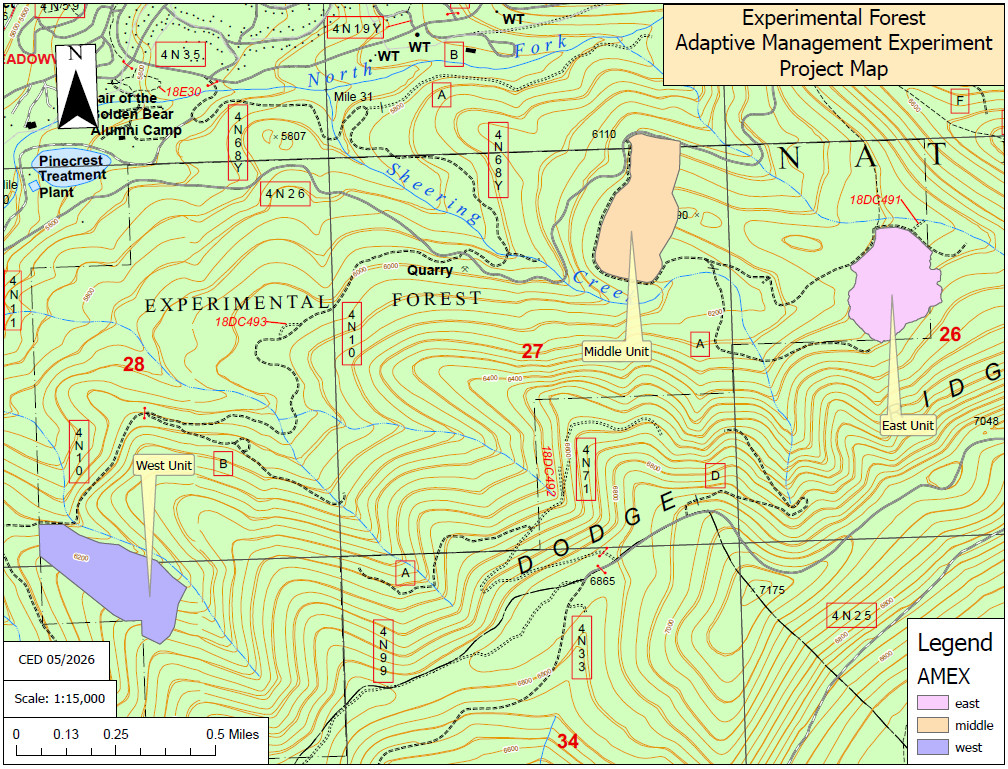
With a planned 96 acres, the RX burn is part of the Sierra Nevada Adaptive Management Experiment (AMEX). AMEX is a multi-partner collaboration (Cal Fire, University of Nevada Reno, University of California Cooperative Extension, US Forest Service) testing different treatments that help forests resist mortality and recover from disturbances.
Established in 2018, the experiment contains nine strategically located sites across the Sierra Nevada to study forest responses to potential extreme mortality events such as drought and high severity wildfire. At the Stanislaus-Tuolumne Experimental Forest, reforestation options are being tested.
Gaps created by thinning were replanted with a mix of six conifer species using seedlings from a variety of elevations and latitudes. Prescribed burns will reduce fuel loads and help protect the Pinecrest Basin as well as this research investment in the event of wildfire.
Burning is contingent on weather, fuel moisture, and air quality. Smoke may be visible from Hwy 108. Fire management officials work with California Air Resources Board and Tuolumne / Mariposa County Air Pollution smoke specialists to plan prescribed burns. Prescribed burns are conducted when weather is most likely to move smoke up and away from our communities. While prescribed fire managers take significant preventive measures, it’s likely that communities may experience some smoke during or immediately after a prescribed burn.
What does this mean for you?
• During prescribed burns, smoke may settle in low-lying areas overnight and in the early morning hours.
• To learn more about wildfire smoke, please visit the Stanislaus National Forest’s Smoke Ready Page
• All residents are encouraged to close doors and windows at night to avoid smoke impacts.
• If available, use a portable air cleaner. Air cleaners work best running with doors and windows closed. You can also create a DIY air cleaner.
• If you have a central air system, use it to filter air. Use high-efficiency filters if possible.
• When driving in smoky areas, drivers should slow down, turn on headlights and turn air to recirculating.
• If you have heart or lung disease, asthma, or other chronic conditions, pay attention to how you feel and if symptoms of heart or lung disease worsen, consider contacting your health care professional.
• Visit When Smoke is in the Air for more smoke preparedness resources.
Weather conditions are evaluated regularly, up to hours before a burn begins. If conditions warrant, scheduled prescribed fire activities may be canceled.
• To learn more about wildfire smoke, please visit the Stanislaus National Forest’s Smoke Ready Page
• All residents are encouraged to close doors and windows at night to avoid smoke impacts.
• If available, use a portable air cleaner. Air cleaners work best running with doors and windows closed. You can also create a DIY air cleaner.
• If you have a central air system, use it to filter air. Use high-efficiency filters if possible.
• When driving in smoky areas, drivers should slow down, turn on headlights and turn air to recirculating.
• If you have heart or lung disease, asthma, or other chronic conditions, pay attention to how you feel and if symptoms of heart or lung disease worsen, consider contacting your health care professional.
• Visit When Smoke is in the Air for more smoke preparedness resources.
Weather conditions are evaluated regularly, up to hours before a burn begins. If conditions warrant, scheduled prescribed fire activities may be canceled.
For more information, contact Stanislaus National Forest Public Affairs Officer, Benjamin Cossel at benjamin.cossel@usda.gov.

Prescribed Burning Operations to Commence in the Experimental Forest added by admin on
View all posts by admin →